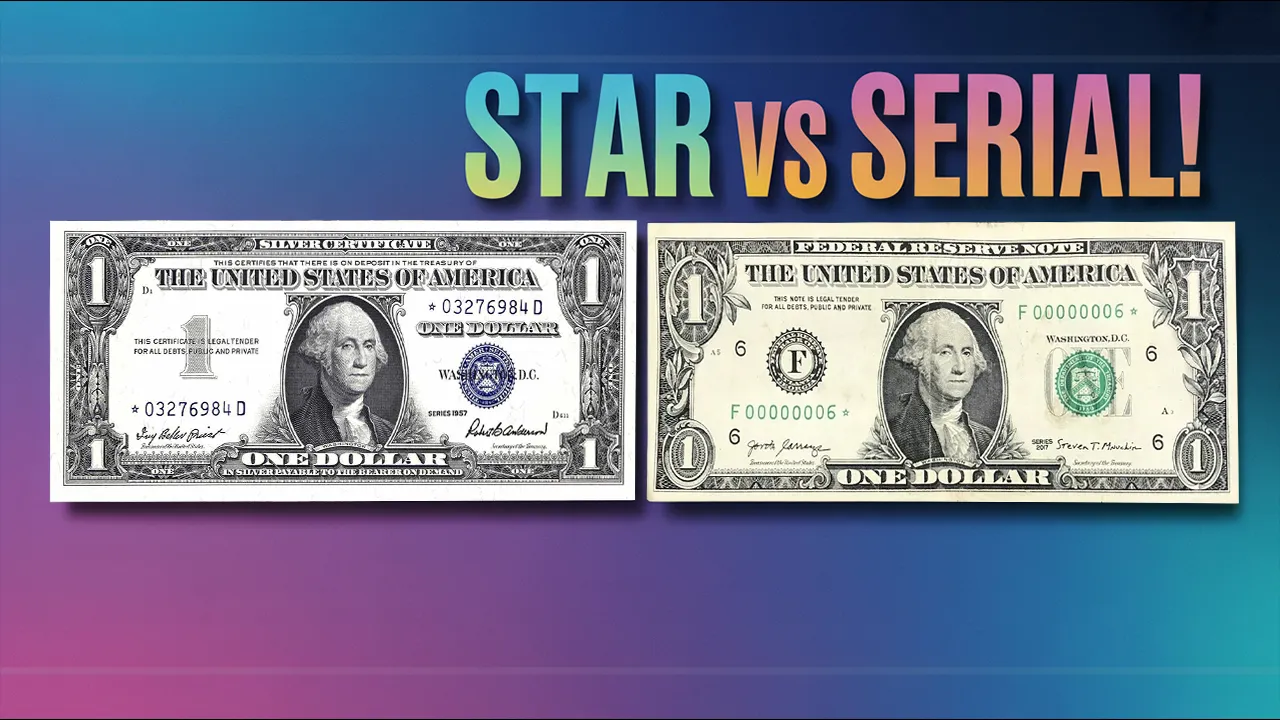
Even in a world dominated by digital money, rare paper bills continue to surprise collectors when they appear in everyday transactions. Among the most talked-about finds are Star Notes and special Serial Number Notes. Both are considered rare for different reasons, and their unexpected appearances in circulation often spark curiosity and excitement. But which one still turns up more often today? And what makes each type so collectible?
What Is a Star Note and Why Is It Special?
A Star Note is a replacement bill printed by the US Bureau of Engraving and Printing when a damaged or misprinted note needs to be substituted. Instead of issuing a corrected version, the BEP prints a new bill with a star symbol at the end of the serial number. These notes are produced in limited quantities, making them far rarer than standard notes. Collectors prize them because they serve as a unique marker of printing corrections and lower production runs.

What Makes a Serial Number Note Valuable?
Serial Number Notes—such as repeating numbers, ladders, birthday notes, solids, radars, or low serial numbers—are prized for their pattern-based uniqueness. These notes are not produced intentionally as collectibles, but their unusual number sequences make them stand out. Because they are not separated from circulation at the source, they can unexpectedly appear in change or ATM withdrawals, creating excitement when discovered.
Key Features Collectors Look For in Rare Bills
- Star symbol at the end of a serial number, repeating or sequential serial patterns, low serial numbers, radar notes, birthday dates, solid numbers, offset printing signs.
Which Bill Type Still Shows Up More Often?
Star Notes are more likely to appear in circulation because they are printed as replacements and routinely enter the money supply. Although still rare, they slip through more frequently than unusual Serial Number Notes, which require an extremely specific pattern to make them collectible. A random Star Note might appear in any stack of bills, while a noteworthy Serial Number Note is far rarer simply due to probability.

However, when a standout Serial Number Note does appear—such as 11111111, 12345678, or a birthdate—it is usually far more valuable than an average Star Note.
Value Comparison Table: Star Notes vs Serial Number Notes
| Bill Type | Rarity in Circulation | Typical Collector Value | Special Value Factors |
|---|---|---|---|
| Star Note | Moderate | $3 to $20 for common notes | Low print runs, older series, crisp condition |
| Serial Number Note | Rare | $10 to several hundred or more | Patterns like ladders, solids, radars, birthdays |
Why These Notes Still Slip Through Today
Many people are unaware of the value behind rare bills. When sorting cash, most individuals overlook Star Notes or unique serial sequences and spend them without a second thought. Because of this, these bills continue to circulate quietly until a sharp-eyed collector spots them. ATM withdrawals and bank cash-outs are also common sources for unnoticed treasures re-entering the system.

The Thrill Behind the Chase
Collectors often describe rare currency finds as modern-day treasure hunts. Each bill offers the possibility of uncovering something unique or historically significant. Stories of people discovering valuable Star Notes or striking Serial Number Notes keep the excitement alive and inspire others to start checking their own money more closely.
Conclusion
Both Star Notes and special Serial Number Notes continue to slip through circulation, but Star Notes appear more frequently due to their intended use as replacement bills. Serial Number Notes, while far rarer, often command higher value when discovered. Together, they remind collectors and everyday users that extraordinary finds can still hide in the most ordinary transactions.

Disclaimer
Values vary based on condition, rarity, and specific serial patterns.